Semiconductor Equipment Sector Strongly Rebounds: In-depth Analysis of Industry Trends and Investment Logic

Keywords: Semiconductor Equipment, Sector Rebound, Lithography Machine, SEMI, Component Price Hikes, Pricing Power Shift

Introduction

On July 21, 2026, A-share semiconductor equipment sector saw a strong rebound, with Zhongke Feice, Zhenbao Technology, Liandong Technology, and over a dozen other stocks hitting the daily limit, rapidly boosting market sentiment. This rally is not an isolated event but the result of multiple positive factors resonating across the global semiconductor equipment industry. From the lithography machine giant raising revenue guidance, to SEMI significantly revising up the 2026 equipment market growth forecast, and the structural shift of industry chain pricing power, the semiconductor equipment and components segment is becoming the core focus of a new industry cycle. Based on the latest market dynamics, this article delves into the industry logic and investment opportunities behind the sector rebound.

1. Sector Rebound: Multiple Positive Factors Resonate

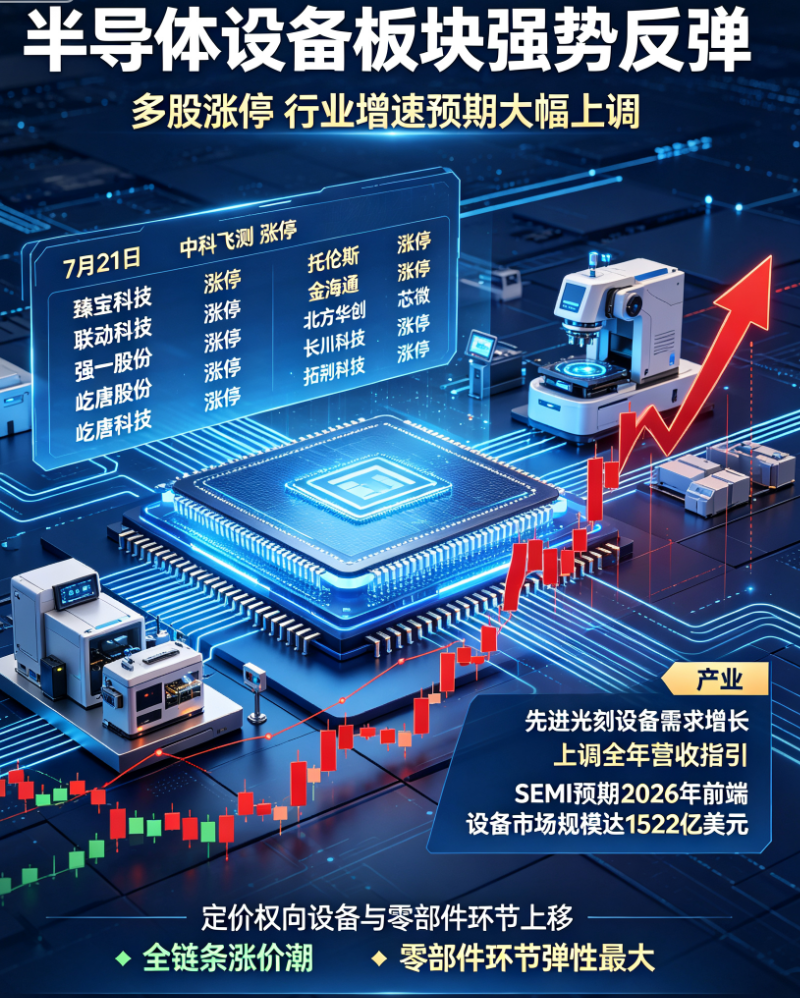
On July 21, the semiconductor equipment sector performed exceptionally well. Zhongke Feice, Zhenbao Technology, Liandong Technology, Qiangyi Inc., Tuolunsi, Yitang Technology, Jinhaitong, North Huachuang, Changchuan Technology, Tuojing Technology, Xinwei Micro, and others all hit the daily limit, with the sector leading the overall market. Behind this explosive rise, there is both short-term capital sentiment and strong support from fundamentals and industry trends.

From an industry fundamental perspective, domestic semiconductor equipment companies are in a period of performance realization. Leading companies like North Huachuang and Zhongwei Company reported high growth in both revenue and net profit in their Q1 2026 reports, with ample order backlogs. Meanwhile, domestic wafer fabs continue to expand capacity, steadily increasing the procurement ratio of domestic equipment. In the first half of 2026 alone, domestic equipment accounted for over 40% of public tenders by major wafer fabs, up about 10 percentage points from the same period in 2025. This dual logic of 'domestic substitution + capacity expansion' forms the underlying foundation for the sector's long-term uptrend.

Semiconductor equipment sector individual stock daily limit situation

2. Continuous Growth in Lithography Machine Demand: Leading Indicator Sends Positive Signals

Recently, the global lithography machine industry leader (widely believed to be ASML) publicly stated that demand for advanced lithography equipment continues to grow and announced an upward revision of the full-year revenue guidance. This signal is significant: lithography machines are the most critical and technologically complex equipment in semiconductor manufacturing, and changes in their demand are often seen as a bellwether for the industry cycle.

The upward guidance from the lithography machine leader is the result of multiple factors. First, new technologies such as artificial intelligence, high-performance computing, and autonomous driving are driving explosive demand for advanced-process chips, prompting capacity expansion for 3nm, 2nm, and below nodes. Second, major global foundries and IDM manufacturers are still accelerating the construction of advanced production lines, with TSMC, Samsung, and Intel alone expected to have combined capital expenditure exceeding $150 billion in 2026. Third, in the memory chip field, with the surge in demand for HBM (High Bandwidth Memory), Samsung, SK Hynix, Micron, and others are continuously increasing their procurement of EUV (Extreme Ultraviolet Lithography) equipment.

The optimistic outlook of the lithography machine giant is essentially a 'directional confirmation' of the entire semiconductor equipment industry chain—investment in advanced processes is still accelerating, with no clear signs of slowing down. This confirmation directly transmitted to the A-share equipment sector, boosting investor confidence in the sustainability of industry prosperity.

3. SEMI Raises Market Expectations: Global Equipment Market Ushers in New Expansion

On June 11, SEMI (International Semiconductor Industry Association) released a report significantly revising up the 2026 global front-end semiconductor equipment market growth forecast from 16.5% previously to 23.5%, corresponding to a market size of $152.2 billion. The magnitude of this adjustment is relatively rare in SEMI's historical forecasts, fully reflecting the strong momentum of current industry expansion.

An in-depth analysis of this data reveals structural changes in the global equipment market. By region, the Chinese mainland market remains the world's largest semiconductor equipment consumer region, expected to account for over 35% of the global share in 2026. Chinese wafer fabs are not only increasing mature process capacity but also accelerating breakthroughs in some advanced processes, driving localization procurement of various equipment including etching, thin film deposition, cleaning, and inspection. By equipment type, etching equipment, deposition equipment, and inspection equipment all grew by over 20%, while lithography equipment, due to its high unit price, became the largest single contributor to market growth.

SEMI's upward revision also reflects the 'multi-polar expansion' pattern of the global semiconductor industry. In addition to China, regions such as the US, Europe, Japan, and South Korea have launched large-scale chip subsidy plans to promote the return of domestic manufacturing. Several wafer fab projects under the US CHIPS and Science Act will enter equipment installation peaks in 2026, and Europe has also initiated multiple advanced and mature process construction projects. This global capacity race provides an unprecedented order window for equipment and component companies.

4. Pricing Power Shift and Component Price Hikes: Structural Opportunities Emerge

China Securities Co., Ltd. recently released a research report pointing out that the pricing power of the semiconductor industry chain is structurally shifting from chip end products to equipment and component segments. Global semiconductor equipment components are experiencing a historically rare full-chain price hike wave, with the component segment being the most elastic direction in the current market. This judgment has profound industry background.

Over the past few decades, value distribution in the semiconductor industry chain has long tilted towards chip design and manufacturing. However, as advanced processes approach physical limits, equipment complexity and cost have risen exponentially. A single EUV lithography machine now costs over €400 million, and key tools like etching equipment and thin film deposition equipment have also seen sharp increases in unit price. More critically, the core components of these equipment—such as RF power supplies, vacuum pumps, gas delivery systems, precision robotic arms, and ceramic parts—have long been monopolized by a few international suppliers with extremely low supply elasticity. Amid demand explosion and capacity tightness, component suppliers' bargaining power has significantly increased, making price hikes inevitable.

Specifically, since 2026, major international component companies have raised product prices multiple times, generally between 10% and 30%, with some scarce categories seeing increases of over 50%. This price hike wave also exhibits a 'full-chain' phenomenon that transmits from upstream to downstream: component price increases → equipment manufacturer cost rise → equipment manufacturer price hikes → wafer fab procurement cost increase. However, wafer fabs, facing strong expansion demand, are relatively accepting of equipment price increases, allowing the price increases to pass through smoothly. Ultimately, the biggest beneficiaries of this price hike are precisely the component suppliers in 'bottleneck' positions.

For A-share related companies, this trend means huge performance elasticity. Currently, a number of domestic component companies with domestic substitution capabilities have emerged, achieving breakthroughs in segments such as electrostatic chucks, RF power supplies, flow control components, and high-purity valves. As domestic wafer fabs and local equipment manufacturers increase procurement of domestic components, the market share and profit margins of these companies are expected to improve simultaneously.

5. Investment Logic and Risk Warnings

Based on the above analysis, the investment logic for the semiconductor equipment and components sector can be summarized at three levels: First, global semiconductor capital expenditure is in a super upcycle, with total equipment demand continuing to expand; second, domestic substitution is accelerating, with domestic companies filling supply chain gaps and transitioning from 'usable' to 'good'; third, the component price hike wave brings profit elasticity, with related companies' earnings likely to exceed expectations.

However, investors should also be aware of potential risks. First, the global semiconductor industry is highly cyclical; if downstream demand unexpectedly declines, wafer fabs may cut capital expenditure, putting equipment orders under pressure. Second, the international trade environment remains uncertain, with some countries possibly tightening export controls on advanced equipment, affecting supply security and technological progress of domestic companies. Third, whether the component price hike wave can continue depends on changes in supply-demand dynamics. If new capacity gradually comes online and supply tightness eases, the momentum for price hikes may weaken.

Overall, the current strong rebound of the semiconductor equipment sector is a rational response to the above industry trends. From a long-term perspective, the value revaluation of equipment and component segments has only just begun. Companies with core technical capabilities, customer barriers, and capacity expansion potential are likely to stand out in future industry competition.

Conclusion

The collective daily limit of A-share semiconductor equipment stocks on July 21, 2026, was a concentrated release of industry logic and market sentiment. The lithography machine leader raising revenue guidance, SEMI significantly revising up market growth, and the global component full-chain price hike—these three signals all point to a core judgment: semiconductor equipment and components are becoming the fastest value-growing segment in the industry chain. For investment, understanding the rules of industry pricing power transfer and seizing the accelerating window of domestic substitution will help seize the initiative in the new cycle. In the future, as more domestic equipment and components achieve high-end breakthroughs, the autonomous controllability of China's semiconductor industry chain will continue to strengthen, and the capital market will continue to witness this historic process.