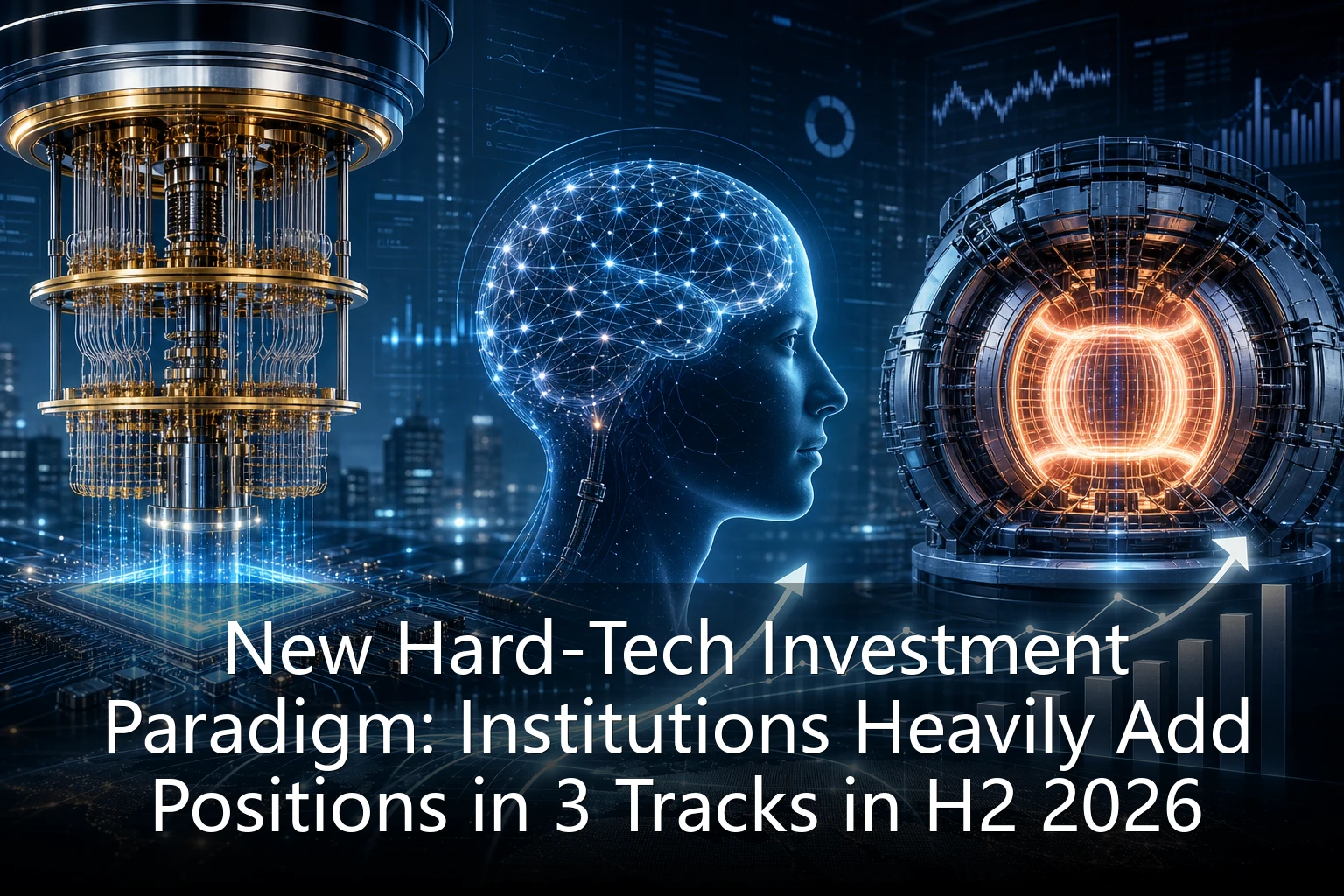
On July 28, 2026, less than a month into the second half of the year, the global hard-tech investment market has seen a new wave of enthusiasm. After quantum computing and synthetic biology led in H1, capital is now accelerating into frontier areas such as brain-computer interfaces, nuclear fusion, and advanced materials at the start of H2. Multiple top institutions stated clearly in their latest quarterly strategy reports that heavy allocation to hard-tech has shifted from "optional" to "mandatory," and the investment logic is moving from "concept speculation" to "commercialization."
1. Latest Developments: Institutions Heavily Adding Positions in Three Tracks
1. Quantum Computing: From Lab to Industry Solutions
On July 27, US quantum computing company Rigetti Computing announced a $1.5 billion strategic investment from sovereign wealth funds and tech giants to advance mass production of its next-generation quantum processors. Meanwhile, China's Origin Quantum recently released the country's first quantum computing financial risk control system, now in trial at multiple banks. Institutions believe quantum computing is transitioning from the "noisy intermediate-scale quantum" (NISQ) stage to a "practical" phase, with the global market size expected to exceed $8 billion in 2026.
2. Brain-Computer Interface: Neuralink's First Human Trial Achieves Major Breakthrough
On July 25, Neuralink released latest clinical data from its N1 implant: three paralyzed subjects achieved over 95% accuracy in controlling a cursor, typing, and operating a wheelchair via thought, with no serious adverse events. This news drove shares of BCI-related stocks higher. Domestically, BrainCo announced its non-invasive BCI rehabilitation device received FDA Breakthrough Device designation, with approval expected by year-end.
3. Nuclear Fusion: Commercialization Accelerates, Multiple Startups Secure Massive Funding
On July 26, US fusion startup Commonwealth Fusion Systems (CFS) closed a $2 billion Series C round, valuing it at over $10 billion, led by Bill Gates' Breakthrough Energy Ventures. On the same day, Chinese fusion company Energy Singularity announced a new 1 billion yuan ($138 million) funding round to build its first magnetic confinement fusion experiment device. The industry widely views fusion as moving from "physics feasibility" to "engineering constructability," with commercialization 3-5 years ahead of schedule.
2. Underlying Logic Behind Heavy Hard-Tech Positions
1. Technology Density Determines ROI
Hard-tech companies typically have extremely high technical barriers and patent moats. For example, Rigetti holds over 800 patents, with error correction technology a generation ahead of peers. This density gives them natural advantages in pricing power and production monopoly; once commercialized, gross margins can exceed 80%.
2. Dual Drivers: Policy and Capital
2026 is a blockbuster year for technology in major economies — the US passed the CHIPS and Science Act 2.0, adding $50 billion for quantum, AI, and biotech; China set up a national hard-tech guidance fund aiming to leverage 1 trillion yuan in social capital. Policy dividends combined with a low-rate environment (Fed holding rates in July) make hard-tech a "certainty track" in the capital winter.
3. Narrative Shift: From "Bottleneck" to "Going Global"
Previously, hard-tech investments were mostly defensive for import substitution, but now the trend is shifting toward "global leadership." For example, Chinese companies in BCI (non-invasive) differentiate from the US (invasive) and are expanding into Southeast Asian and African markets. This global market space is incomparable to traditional hardware investments.
3. Industry Insights: The "Impossible Trinity" of Hard-Tech Investment and Breakthrough Points
However, hard-tech investment is not without risk. High capital, long cycles, and high failure rates form an "impossible trinity." An anonymous VC partner said: "We invest in 10 fusion projects; maybe only one will reach commercialization, but that one's return covers all losses."
To address this, institutions are adopting a "combined approach":
- Invest early and small: Enter at seed and Series A rounds at lower valuations, requiring founders to co-invest to align interests;
- Vertical chain coverage: Span from upstream materials to downstream applications, e.g., investing in both quantum chip companies and quantum cloud platforms;
- Government matching funds: Partner with government guidance funds to reduce single-investor risk.
Notably, valuation logic for hard-tech in secondary markets is also changing. The CSI Hard-Tech Index's P/E (TTM) fell from 80x in 2025 to 60x in July 2026, but its P/B remains above 5x, indicating market recognition of asset scarcity but a demand for more realistic earnings expectations.
4. Outlook: Investment Indicators for H2 2026
Looking ahead, analysts highlight these trends:
- Dense issuance of quantum computing ETFs: Asset managers like BlackRock and Invesco have filed for the world's first quantum computing theme ETFs with the SEC, expected to launch in August;
- BCI regulatory framework finalized: The FDA plans to release BCI device approval guidelines by end-2026, clearing regulatory uncertainties;
- Nuclear fusion supply chain rise: Orders for high-temperature superconducting materials and vacuum chamber manufacturing will surge; related listed companies worth tracking.
Overall, heavy bets on hard-tech are no longer just "emotional investment" but a rational choice based on technology maturity and commercialization prospects. As the CEO of SoftBank Vision Fund said in a closed-door meeting on July 27: "We are on the eve of the Cambrian explosion of hard-tech; if you don't position now, you'll miss the train in ten years."
For individual investors, direct participation in early-stage projects has high barriers, but by investing in hard-tech thematic funds, ETFs, or tracking listed companies' hard-tech deployments, they can share in the technology revolution's dividends. Of course, position control and diversification are necessary to avoid over-concentration in a single track.