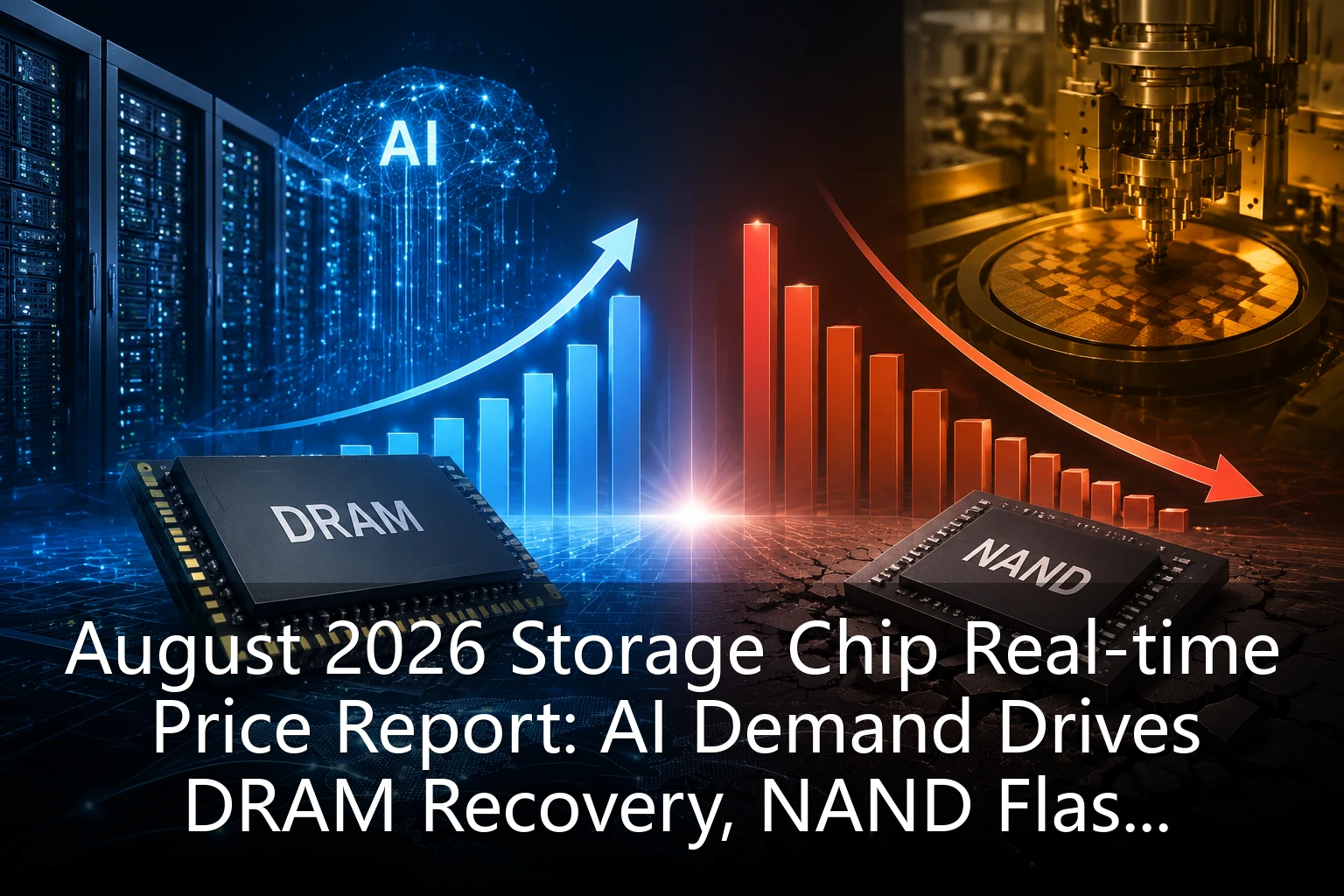
August 2026 Storage Chip Market Panorama: New Price Trends Under a Divergent Landscape
\n\nThe storage chip market in August 2026 shows a clear divergent pattern, with DRAM prices recovering from declines under strong support from AI server demand, while NAND flash prices continue to bottom out. This divergent trend reflects the differentiated performance of different storage technology routes in the current market environment and indicates that the storage industry chain will undergo a new round of structural adjustments.
\n\nDRAM Price Recovery: AI Server Demand as Key Driver
\n\nAccording to the latest market data, DRAM spot prices showed a moderate upward trend in August 2026, with DDR5 contract prices leading the increase, reaching a growth rate of 0.33%, the highest in nearly three months. This recovery is mainly attributed to the strong demand for high-performance memory from AI servers. As large language model training and inference workloads continue to increase, data center demand for high-bandwidth, low-latency DDR5 memory continues to climb.
\n\nIndustry analysts point out that the demand characteristics of AI servers for DRAM are significantly different from traditional servers. AI servers typically require larger capacity memory modules and higher bandwidth, which directly drives the price increase of DDR5 and higher-spec memory products. In addition, AI applications have higher requirements for memory reliability and stability, further increasing the market premium for high-end DRAM products.
\n\nFrom a regional market perspective, the recovery of DRAM prices shows an imbalanced characteristic. In North America and Europe, DRAM prices have increased more significantly due to accelerated AI data center construction; while in the Asian market, especially China, DRAM price increases have been relatively moderate due to domestic AI server capacity expansion. This regional difference reflects the imbalance in the global AI infrastructure construction process.
\n\nNAND Flash Prices Continue to Bottom Out: Weak Consumer Electronics Demand Dominates Market
\n\nIn stark contrast to the DRAM market's recovery, the NAND flash market continued to face pressure in August 2026, with prices continuously bottoming out. Consumer SSD prices have fallen to historic lows, with some models dropping more than 30% from the beginning of the year. Enterprise SSDs, while relatively resilient, are also facing downward pressure.
\n\nThe main reason for the continuous decline in NAND flash prices is weak consumer electronics market demand. Global smartphone and personal computer shipment growth has been sluggish, leading to slower growth in demand for storage capacity. Meanwhile, the expansion plans of major storage manufacturers over the past two years have gradually released capacity, making the market oversupply problem increasingly prominent.
\n\nNotably, the NAND flash market has also shown clear internal differentiation. PCIe 4.0 and PCIe 5.0 SSDs have relatively stable prices due to their performance advantages; while traditional SATA SSDs, with their high technical maturity and fierce competition, continue to see price declines. This differentiation reflects the trend of the storage market shifting toward high-performance, high-value-added products.
\n\nAnalysis of Storage Chip Price Differences Across Different Application Fields
\n\nIn August 2026, the price trends of the storage chip market showed significant differences across various application fields, reflecting the different demand characteristics and market environments of various industries for storage technology.
\n\n- \n
- Data Center Sector: The boom in AI data center construction has driven a surge in server storage demand, with DDR5 RDIMM and LRDIMM prices rising against the trend, with some high-end products increasing by more than 5%. Meanwhile, enterprise SSDs, needing to meet high-performance computing requirements, have maintained relatively stable prices. \n \n
- Consumer Electronics Sector: The slowdown in smartphone and PC market growth has led to continuous price declines in consumer storage products. Especially eMMC storage and entry-level SSDs used in traditional smartphones have approached the cost line, with some manufacturers considering production cuts. \n \n
- Automotive Electronics Sector: With the popularization of smart vehicles, in-vehicle storage demand is growing rapidly. Automotive-grade NAND and DRAM, due to high reliability requirements, have relatively stable prices and show a slow upward trend. This trend is expected to continue, becoming an important growth point in the storage market. \n \n
- Industrial Control Sector: The advancement of Industry 4.0 has driven industrial storage demand growth, with strong demand for high-reliability, wide-temperature-range storage products. Industrial SSD and DRAM prices remain stable, with some high-end products even facing supply shortages. \n
Industry Chain Impact and Response Strategies
\n\nThe divergence in storage chip prices has had a profound impact on various links of the industry chain, prompting related companies to adjust strategies to cope with market changes.
\n\nFor storage chip manufacturers, market differentiation means optimizing product structure and increasing the proportion of high-value-added products. Traditional storage giants like Samsung, SK Hynix, and Micron are accelerating their transition to high-end products such as HBM (High Bandwidth Memory) and enterprise SSDs to cope with the pressure of falling consumer product prices.
\n\nFor equipment manufacturers, changes in storage chip prices directly affect product cost structure. PC and smartphone manufacturers are actively taking advantage of falling NAND flash prices to increase product storage capacity and enhance market competitiveness. Server manufacturers, however, face cost pressure from rising DRAM prices and need to reduce dependence on storage chips through technological innovation.
\n\nFor distributors and system integrators, price fluctuations in storage chips have increased inventory management difficulties. Especially against the backdrop of continuously falling NAND flash prices, balancing inventory costs and market demand has become a key challenge. Some leading distributors have begun adopting dynamic pricing strategies to cope with market price fluctuations.
\n\nExpert Views and Market Forecasts
\n\nIndustry experts hold different views on the market trend of storage chips in the second half of 2026, but generally believe that the market differentiation trend will further intensify.
\n\nMorgan Stanley's technology industry analyst stated: "AI server demand will continue to support DRAM prices, especially in the DDR5 and HBM sectors. We expect DRAM prices to maintain a stable upward trend in the second half of 2026, with a possible increase of 3-5%."
\n\nCitibank's semiconductor industry analyst, however, takes a cautious view of the NAND flash market: "The price bottoming process for NAND flash may continue until the end of 2026. With the implementation of production reduction plans by major manufacturers, the market is expected to bottom out and recover in the first quarter of 2027. Until then, downward price pressure will persist."
\n\nAn executive from a domestic storage chip company stated: "China's storage chip industry is entering a critical opportunity period. In the DRAM field, domestic manufacturers are gradually narrowing the gap with international giants through technological innovation; in the NAND field, domestic manufacturers are focusing on differentiated competition and developing specific application markets. It is expected that the market share of domestic storage chips will continue to increase in the second half of 2026."
\n\nFuture Outlook: Technological Innovation and Market Restructuring
\n\nLooking ahead, the storage chip market will face multiple changes, with technological innovation and market restructuring becoming the main trends.
\n\nAt the technological level, storage technology is developing toward higher density, higher performance, and lower power consumption. New-generation storage technologies such as DDR6 and HBM4 are under development and are expected to be gradually commercialized between 2027-2028. Meanwhile, emerging technologies such as computing-in-memory and storage computing will also bring new growth points to the storage market.
\n\nAt the market level, the storage chip industry chain will face restructuring. As geopolitical factors increasingly affect global supply chains, the storage industry shows clear trends of regionalization and diversification. Emerging manufacturing bases in Southeast Asia, India, and other regions are rising, and the global storage industry chain layout will become more dispersed.
\n\nFor investors, the differentiation of the storage chip market means more precise identification of investment opportunities. In the DRAM field, focus on AI server memory suppliers and HBM technology leaders; in the NAND field, focus on suppliers of differentiated products such as automotive-grade and industrial-grade products. At the same time, paying attention to upstream enterprises in the industry chain such as storage equipment and testing equipment may also bring unexpected returns.
\n\nOverall, the storage chip market in August 2026 shows a divergent trend between DRAM and NAND price movements, reflecting the differentiated performance of different storage technology routes in the current market environment. With the deepening development of AI applications and the continuous adjustment of the consumer electronics market, the storage chip market will usher in a new round of structural changes, and related companies need to adjust their strategies in a timely manner according to market changes to seize development opportunities.